About The Horror Codex
A searchable, community-driven database of every horror film ever made.
66,629 horror films, sorted.
You might be asking yourself why a site like this exists when we already have Letterboxd and IMDB. Valid question! They’re both great sites, don’t get me wrong — they’re just not built for horror fans. As horror fans, we know that grouping Shaun of the Dead and Rosemary’s Baby under the same catch-all genre makes little sense, if any at all. We know that The Texas Chain Saw Massacre is a 5 star film, not a 3.8. We see the value in the low-budget transgressive flicks that get buried on the mainstream sites. And we know that so-called horror-adjacent films like Under the Skin and A Clockwork Orange both contribute to and owe huge debts to horror, belonging in these conversations, even if other sites group them with more pedestrian fare.
The Horror Codex is a site built by horror fans, for horror fans. Where the entire shape and color of the genre—the history, the ratings, the taxonomy, the guts and the gore—are on full display, undiluted by the casuals. It’s a shrine to the genre we love, a menu for a Saturday evening double feature, and a community building a tome that will guide future generations of horror nuts. But it didn’t start out as all that. It started as a quick experiment to see if I could classify every horror film ever made into proper subgenres.
As far as I could tell, a full taxonomy exploration, applied to the entire catalog of horror films, had never been done. Yes, there are extensive lists of slasher flicks and sharksploitation films on Wikipedia and Letterboxd. And obviously, it’s pretty easy to search on keywords like “vampire.” But sorting the entire lot into proper places… someone had to at least give it a go. And I had a little bit of free time.
The first week was pretty futile, filled with false positives and orphaned films as I tried to programmatically translate keyword data to subgenres. But eventually I did it… I won’t bore you with the details, but I built a system that would sort not just the easy ones, like Werewolf or Alien films, but also nuanced ones like Gaslighting and Trauma flicks with an accuracy that bordered on shocking.
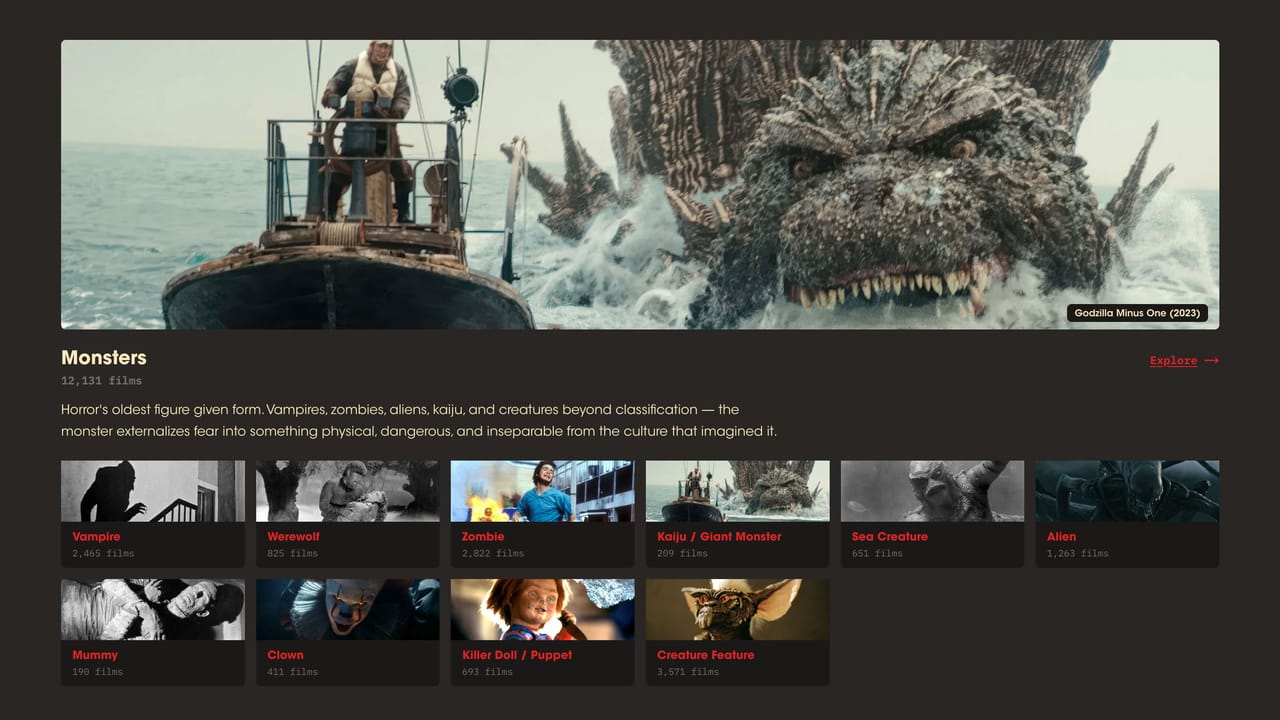
I designed the taxonomy around Bruce F. Kawin’s Horror and the Horror Film (at Connor’s recommendation), which insists on sorting films based on the brand of horror central to the film. Monsters, Supernatural & Occult, Human Monsters, Psychological, Body & Contagion, and Nature. Then I added categories for Genre Hybrids like Western or Holiday Horror, and Movements & Traditions like Folk Horror or Giallo. Certain decisions here may seem unconventional, such as filing re-animation films like Frankenstein under Mad Science, rather than Monsters. But you’re going to have that with any taxonomy that aims to be exhaustive. Ultimately, this proved to be a rather consistent and straightforward way to organize the films.
Having succeeded in my experiment, I had little choice but to make the data searchable. Which led to another thing I thought someone ought to have done by now: replicate the VHS rental experience in a digital setting. The film detail page is for deep research. For picking a film to watch, one needs no more than what appears on the back of a VHS cover. Click on a cover, get a picture, some credits, and a short description of the movie. Browsing movies should be as low-friction as possible, so I spent a lot of time optimizing this experience. Once I had that worked out, I thought… what if I could easily rate films and mark them as seen, then dim seen films out when I’m looking for something new to watch? And furthermore, what if I could filter them not just by keywords or genres, but by the available catalog on different streaming services! So I built that.
Then came search operators. Want to see every film for which Tom Savini did practical effects? Previously, you’d have to do some digging to find his Special Effects credits on IMDB. Here, it’s as easy as searching fx:"Tom Savini". Turns out it’s pretty magical what you can uncover when you combine search filters, keywords, and specialized operators. Far easier than searching the information superhighway for curated lists of niche films.
Then I thought, “What if this data could be improved upon?” What if users could contribute their own expertise, improving the sorting and keywords, adding notes, relevant links, and film stills, and suggesting related films? What if the Film Details page became a wiki of sorts, open to improvement over time? So I built that.
Then came the browse sections, and charts that express different genres’ evolving popularity across decades and countries. Even an interactive world map that highlights how many horror films each country has produced.
I guess you could say I fell down a rabbit hole. Call me Alice. I knew I had pretty much lost it when I was building out cluster maps for user profiles in order to recommend new films based on their film ratings history. But here we are, topside again.
Now that the site is built, I have a new goal. It occurred to me that the ratings of horror films on general film sites like Letterboxd or IMDB are dragged down by non-horror fans. How would ratings look different if horror fans were allowed to share their opinions about horror and horror-adjacent films undiluted by the masses? We could find out.
I hope the Horror Codex is educational. I hope that it reveals the shape and significance of horror over time. But I also hope it’s a quick tool for finding something new to watch. I hope it’s a safe space where you’re free to rate Cannibal Holocaust 5 stars or The Shining 2 stars (as Stephen King likely would). And I hope that it becomes a community that contributes ratings and notes and links and lists to the codex, creating an invaluable resource for generations of horror fans to come. It is—at its very core—a project by horror fans, for horror fans. And I hope it grows into something great.
Want to know more? Check out the Frequently Asked Questions, or sign up to get started.